CC
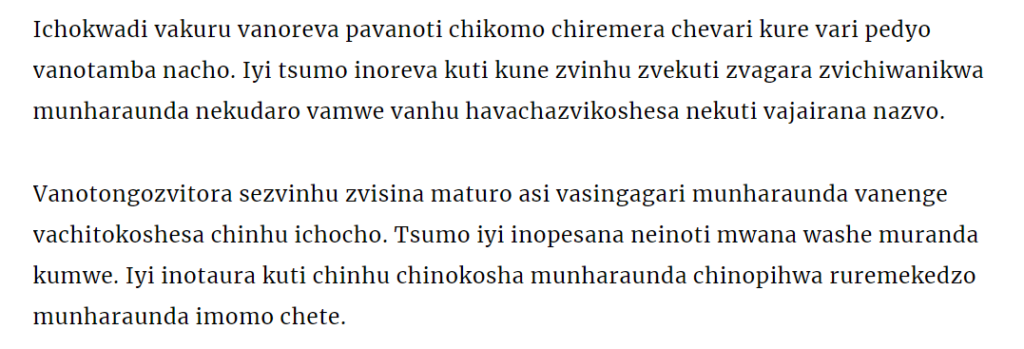
Chikomo Chiremera Chevari Kure Vari Pedyo Vanotamba Nacho
Why Do We Value What’s Distant and Neglect What’s Near? Why Do We Get Taken For Granted?
Chitiyo Kupinda Muzai Huona Amai
Proverb meaning “If a chick were to go into an egg, it would just be imitating the hen,” conveying that children naturally take after their parents’ traits and behaviors, whether good or bad, like a child picking up a parent’s habits, similar to “Like mother, like daughter” in English.
Here’s a breakdown:
Chitiyo: Chick.
Kupinda Muzai: To go into an egg.
Huona Amai: It would be imitating the mother/hen.
Chiri Mumusakasaka Chinozvinzwira
Proverb meaning “People in a group setting often take advice or things that specifically benefit them, while ignoring what doesn’t.” It highlights self-interest in communal situations, suggesting individuals filter guidance to suit their needs, much like someone might pick what they want from a shared basket (musakasaka).
Chiri: What is mumusakasaka: in the shared basket/heap (implying a group/communal item)
chinozvinzwira: (it) understands/takes for itself (its own needs)
Chaitemura chava kuseva
Meaning: From rags to riches. Below are proverbs with similar meaning.
1. Chaikanya chototsa
2. Chaitotsa chokanyawo.
Chara chimwe hachitswanyi inda
One person is limited in what he can achieve compared to team effort. Chara chimwe translated to Shona means a thumb finger. Inda means a louse. Translating this Shona proverb to English, it means one finger cannot crush a louse.
Similar Proverbs:
1. Mombe haipingudzwi nomunhu mumwe.
2. Ndarira imwe hairiri.
3. Rume rimwe harikombi churu.
Chitsva Chiri Murutsoka
Proverb meaning “New things are in the foot” or “You get new experiences by moving to different locations,” encouraging travel, exploration, and stepping out of your comfort zone to find new opportunities and perspectives, rather than staying stagnant.
Literal Translation: “New things are in the foot/shoe”.
Deeper Meaning: It’s about the idea that to find new things, learn new lessons, or achieve new results, you must be active and move, literally or figuratively, to new places or stages in life.
Application: It can apply to seeking new job opportunities, understanding different cultures, or progressing in life by taking action rather than waiting for things to happen.
Charovedzera Charovedzera Gudo Rakakwira Mawere Kwasviba
Proverb meaning that what you are used to doing, you can do with ease even under difficult or dark circumstances, illustrating that familiarity breeds competence and confidence. It translates literally to “What’s familiar, is familiar; the baboon climbed the steep cliff in the dark,” emphasizing that experience allows one to perform well despite challenges.
Literal Translation: “What’s familiar, is familiar; the baboon climbed the steep cliff in the dark”.
Deeper Meaning: A person accustomed to a task (like a baboon to climbing) can accomplish it effortlessly, even when conditions are poor (like darkness), because of their ingrained skill and experience.
Application: It’s used to describe situations where someone succeeds easily due to practice, overcoming doubts from others.
Chenga ose manhanga hapana risina mhodzi
Literal Meaning:
- Chenga ose manhanga: Collect/keep all the pumpkins.
- Hapana risina mhodzi: There isn’t one without seeds.
Deeper Interpretations:
- Value everyone: Treat all people with respect and dignity, as each has unique worth and potential, much like every pumpkin yields seeds for future growth.
- Don’t discard opportunities: Don’t give up on ventures or relationships too quickly; the benefits might not be apparent at first glance.
- Perseverance: There’s value in trying everything; even unlikely efforts can yield rewards.
Application:
- Parents should value all children equally.
- In business, don’t dismiss a potential partner or idea prematurely.
Chomujiri ndechemhanza chemudzimu ndechewadanirwa
Literal sense:
- Chomujiri – what comes by chance / accident
- Chemhanza – luck or fortune
- Chemudzimu – what comes from the ancestors / spiritual calling
- Ndechewadanirwa – is something you are called to, summoned to, or destined for
Meaning:
What comes by chance is just luck, but what comes from the ancestors (or the spirit) is a calling.
Deeper interpretation:
The proverb contrasts random success with destined purpose. It says:
- Some things happen to you because of luck or coincidence.
- Other things happen because they are tied to your calling, destiny, or ancestral mandate—and those are not accidental.
In Shona worldview, if something keeps pulling you, follows you, or persists despite resistance, it may not be mhanza (luck) but kudanirwa—a calling linked to your spiritual lineage.
How it’s often used:
- To explain why someone cannot escape a certain role (healer, leader, artist, mediator, etc.)
- To remind people not to dismiss deep, recurring paths as “just luck”
- To emphasize respect for ancestral purpose over coincidence
In short: Luck may open doors, but destiny calls you through them.
Charova sei chando chakwidza hamba mumuti
Proverb meaning: How cold must it be that even a tortoise climbs a tree?” It signifies that extreme hardship or unusual circumstances force people (or things) to do things they normally wouldn’t, leading to surprising or unexpected behavior to survive or cope. It’s used to comment on desperate situations that cause extraordinary actions.
Literal Translation: How cold | hard it must be that a tortoise climbed a tree.
Figurative Meaning: When people face severe difficulties, they resort to extreme or out-of-character measures, like a cold-blooded tortoise climbing a tree to find warmth.
Application: It highlights that dire situations can make anyone act unexpectedly, similar to how a wise person might seek help from a fool, or a rich person becomes destitute. Similar proverbs: Zvina mashura dede kuwa mumuti.
Chava chigondora chava chimombe kutadza kutunga hurema hwacho
Proverb meaning: When a wild dog becomes a domestic dog, it fails to hide its wildness/bad habits, implying someone who changes their ways or status but still retains their inherent negative traits, unable to truly reform or disguise their true, flawed nature. It’s about inherent flaws being hard to shake off, no matter the outward change.
Chava chigondora: It has become a wild dog (or jackal).
Chava chimombe: It has become a domestic animal (cow/cattle).
Kutadza kutunga hurema hwacho: Failing to cover/hide its flaws/wildness.
Essentially, even if you dress up a bad person (or situation) in fine clothes (like a cow), their inner wildness (chigondora) will still show, often through their actions or character.
Chakanaka chakanaka mukaka haurungwi (munyu)
Proverb means what’s good is good, milk can’t be made into a ball (with salt),” conveying that you can’t improve upon something already perfect or natural; it’s about respecting inherent qualities, not forcing additions (like salt) that spoil something good (milk). It teaches that some things are naturally complete and don’t need alteration, emphasizing integrity and accepting things as they are, rather than trying to change their essence.
- Literal Translation: “What is good is good, milk does not become solid (with salt).”
- Meaning/Interpretation:
- Don’t try to fix or add to something that is already perfect.
- You can’t change the fundamental nature of something.
- It advises against spoiling something inherently good by trying to make it “better”.
- Context/Usage: Used to caution against unnecessary interference or to praise something for its inherent goodness, suggesting it needs no additions.
Chinoziva ivhu kuti mwana wembeva anorwara
Proverb meaning only those closest to you truly understand your deep problems or feelings, emphasizing intimacy and proximity for true knowledge, similar to how the ground near a mouse’s nest knows its condition better than outsiders. It highlights that outsiders often see only the surface, while family or close community members understand the hidden struggles or inner turmoil.
Literal Meaning: The soil/earth (ivhu) knows (chinoziva) that the baby mouse (mwana wembeva) is sick (anorwara).
Deeper Meaning: Those who are physically and emotionally close to someone are the ones who truly grasp their internal issues, pain, or challenges.
Application: It advises against making assumptions about others’ lives and emphasizes the importance of close relationships for understanding reality, as seen during crises like Cyclone Idai where survivors’ voices were most critical.
Chinokanganwa idemo asi chitsiga hachikanganwe
This proverb carries a powerful meaning about the nature of harm and memory, emphasizing that while the perpetrator of a harmful act might move on and forget, the victim (or the consequences of the act) remembers the pain and the impact.
Perpetrator vs. Victim: The axe is the instrument that inflicts the harm and is immediately done with the action (it “forgets”). The stump, having suffered the damage, carries the marks and the memory of the event indefinitely.
Consequences of Actions: It serves as a caution that actions have lasting consequences, even if the person who committed them doesn’t dwell on them.
Chimwe nechimwe chine nguva yacho.
The proverb translates directly to “Everything has its own time”.
It is a profound piece of wisdom emphasizing patience, proper timing, and divine order in life events.
Core Meanings and Context
- Patience and Endurance: The proverb teaches that you cannot rush success or force a season to change before its time. Just as crops need a specific season to grow, personal success, healing, or breakthroughs have appointed times.
Application
This proverb is used to console someone experiencing misfortune (encouraging them that better times will come) or to caution someone against greedily rushing into situations before they are ready. Key Takeaway: Do not despair in hard times, and do not be arrogant in good times; trust that every situation has its appointed moment.
Chidziva chakadzikama ndicho chinogara ngwena.
Meaning: a calm or quiet pool is where the crocodile lives. It translates literally to: “The quiet pool is the one in which the crocodile lives.” It serves as a warning against underestimating quiet or harmless-looking people, as they may be dangerous or harbor hidden dangers.
Key Aspects of the Proverb:
- Do Not Judge by Appearances: Just as a calm, still pool looks harmless but hides a dangerous crocodile, a person’s quiet or humble demeanor does not necessarily reflect their capacity for action or danger.
- Danger Lurks in Silence: It is often the silent, unassuming individuals who can cause the most damage or hold dangerous secrets.
- Cautionary Advice: It advises one to be observant and not dismissive of quiet situations or individuals, as unexpected threats often arise from such places.
In essence, the proverb advises vigilance and caution, suggesting that outward calmness can mask inward danger.
Chakabaya chikachokera.
Translates literally to “What pierced [stabbed/stung/injured] has moved on/gone.”
It is used to convey several key meanings:
- Actions Have Consequences: The proverb means that once you have initiated an action, particularly a negative or harmful one, you must accept that it has set something in motion that cannot be easily undone or recalled.
- The Past Cannot Be Altered: Once a wrong is done or a word is spoken, it is gone (“chikachokera”). You cannot go back in time to fix it.
- Finality of Actions: It is often used to suggest that if you have initiated a conflict or caused pain, you should expect that action to follow its course or for the target to be affected.
It is often used in situations where someone is dealing with the lasting results of a past action, or as a warning to think before acting because once the “piercing” occurs, you cannot undo it.
Chakatanga ndochakachenjedza.
Once bitten, twice shy
Chikuriri chine chimwe.
What was once great will be smaller at some point in life.
Chakafukidza dzimba matenga.
There are things that are not so obvious that happen behind the scenes in every home.
Chisi hachieri musi vacharimwa.
You reap what you sow not now, but later. If you do something bad, you will face the consequences.
Chisingaperi chinoshura.
All things have a beginning and an end.
Chako ndechako kuseva unosiya muto.
When you are using your own things, you make reservations for future use.
Chavavana batisisa mudzimu haupi kaviri.
Opportunities com once in life.
Chawawana idya nehama mutorwa ane hanganwa.
Chidamoyo hamba yakada makwati.
To choose what you want even if it doesn’t appeal to other people.
Chada mwoyo hachikoni, mwoyo chiremba.
To chase your dream until you get it.
Chura kugara mumvura handi kunwa.
Chiri mumoyo chiri muninga unofa nacho.
Secrets that remain buried inside you till death.
Chirema ndechina mazano chinotamba chakazendama kumadziro.
A disadvantaged person plays it safe in case anything goes wrong. They have something to fall back on.
Chinokura usipo imombe munda unokura nokuvandurirwa.
Translation – Unlike cattle which will grow even in your absence, a field grows by being extended.
Application
For something to grow and prosper one needs to put in the required effort, and constantly attend to it.
Chitaurirwa mbare dzekumusana.
Experiencing things first hand differs from being told.
Chembere masikati usiku imvana.
Vamwe vanhu vanokwanisa kuvanza mamwe maitiro avo kana vari paruzhinji asi kana vari pakahwanda vane mamwe.
Chembere mukadzi hazvienzani nekurara mugota.
It’s better to have something not so good than to have nothing.
Chinokura chinokotama musoro wegudo chave chinokoro.
Situations change with the passing of time.
Chitende chinorema ndechine mhodzi.
Empty tins make a lot of noise.
Chinonzi regedza ndechiri mumaoko chiri mumoyo unofa nacho.
A person can change their habits, but cannot easily change their nature. Ingrained habits, now second nature, become difficult to remove or change.
Chirere mangwana chigozokurerawo.
Take care of a youngster. One day, that person will take care of you.
China manenji hachifambisi chinomirira kuti mavara acho aonekwa.
Chinono chine’ngwe bere rakadya richifamba.
You must make hay while the sun shines. Do things hastily.
Chiri pamuchena chiri pamutenure.
If you have nothing, whatever you get doesn’t seem to last. It’s like putting money in a pocket with a hole.
Mwoyo Muti Unomera Paunoda
Translation: The heart is like a tree, it sprouts where it chooses.
Afirwa Haatariswe Kumeso
Literal meaning: You can’t look directly into a bereaved person’s face. When a person is bereaving, it’s not the right time to be probing them with many questions.
Aiva Madziva Ava Mazambuko
Meaning: Things change over time. For example, those who were once rich are now poor.
Other proverbs with a similar meaning:
(1) Bvupa jena rakabva munyama
(2) Dzaiva nhungo dzava mbariro
(3) Kwava kusakara kwedoo kuita serisakambodyiwa nyama
(4) Chinokura chinokotama musoro wegudo chava chinokoro.
Atswinya Arwa
If you try, at least you have done something, no matter how small it is.
Akanga Nyimo Avangarara
Meaning: setting a hard goal but working hard to achieve it. Other proverbs with a similar:
(1) Ateya mariva murutsva haatye kusviba magaro
(2) Atanda nondo haachatyi kureba makanga.