
More Than Words: Why I am Proud of My Zimbabwean Accent
Did you know Zimbabwe boasts a staggering 16 official languages? Among them, English is widely spoken across the country. But here’s the fascinating part—our Zimbabwean English accent carries something much deeper than just words.
Have you ever wondered why people around the globe speak English with such vastly different accents? The exact same phenomenon happens right here in Zimbabwe. But our accent isn’t just a byproduct of geography; it reflects our history, our roots, and our rich cultural identity.
The Connection Between Shona Dialects and the Zimbabwean Accent
Within Zimbabwe, the Shona language alone has multiple distinct dialects. Interestingly, the specific dialect you grow up speaking heavily shapes how you pronounce English words. Once I made this connection, I realized something powerful:
Accents aren’t just about sound—they’re about who we are.
Each Shona dialect connects the speaker to a specific community, region, or even a single village. They serve as cultural fingerprints, completely unique to every group. When we speak English with our distinct Zimbabwean accent, we’re actually carrying living pieces of our history with us.
What Exactly Is a Dialect?
The Cambridge Dictionary defines a dialect as “a form of a language spoken in a particular part of a country, containing unique words, grammar, and expressions.”
Dialects are shaped by region, community, and social settings. For instance, the way you converse with family at home likely differs from how you speak in a corporate office or a university lecture hall.
In Zimbabwe, dialects give us a profound sense of belonging. When it comes to Shona, these dialects are incredibly rich and diverse.
The 5 Major Shona Dialects Shaping Our Voices:
- Korekore (Northern Shona): Includes groups like Tavara, Budya, and Pfungwe.
- Karanga: Such as Duma, Jena, and Nyubi.
- Ndau: Including Garwe and Danda.
- Zezuru: Groups like Shawasha, Hera, and Njanja.
- Manyika: Such as Hungwe, Nyatwe, and Bvumba.
Each dialect carries its own ancestral history, stories, and linguistic cadence.
(Curious about how the Shona language was standardized and who engineered it? [Read the full history here])
Zimbabwean English: A Living, Breathing Identity
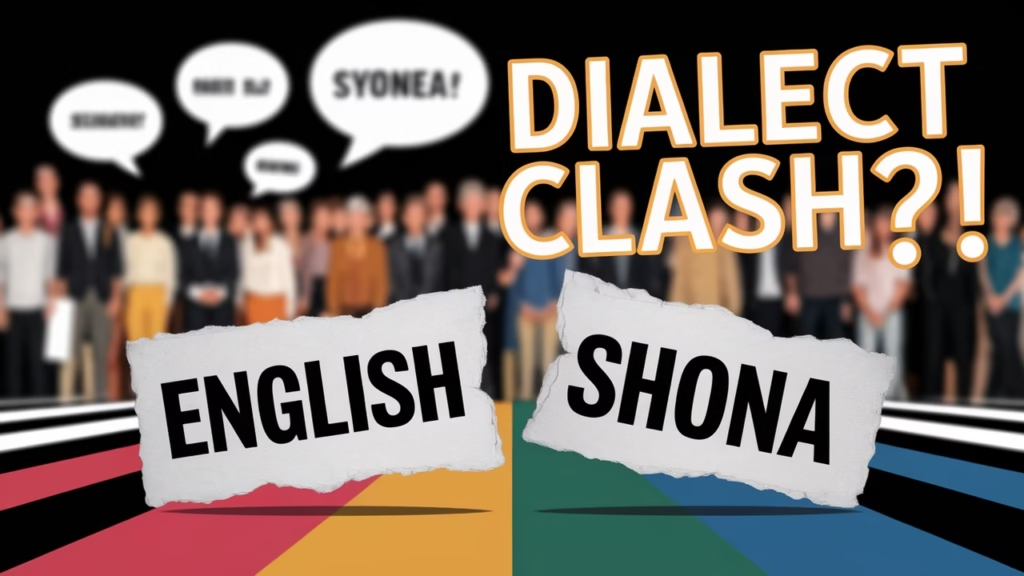
Our version of English obviously has its roots in British English, but it has been beautifully remolded by Shona, Ndebele, and other local indigenous languages. That fusion is what makes it uniquely ours.
Growing up in high school, I vividly remember how classmates who spoke with a forced, “eloquent” British or American twang were teased as the “nose brigade” (because they seemingly spoke “through their noses”). Back then, many people didn’t celebrate authentic Zimbabwean English.
Today, however, I see that our accent is something to be fiercely proud of. It is our own localized dialect of English—just as valid as the accents proudly spoken by Australians, Americans, or the Irish.
Here’s the irony: someone who alters their voice to sound “polished” in Zimbabwe might still sound completely foreign in the UK, where regional accents vary wildly from London to Yorkshire. The truth is, there is no single “perfect” English—only versions shaped by history, geography, and culture.
Why We Should Celebrate Our Linguistic Heritage
Research indicates that most Zimbabweans who speak English naturally carry phonetic influences from the Shona language (Mlambo, 2009). This explains why our vowels and consonants might sound different to an outsider’s ear. But instead of shying away from our natural intonations, we need to embrace them.
Languages and accents are meant to evolve. What matters most is that they accurately reflect our identity. As Zimbabwe’s educational curriculum begins to include more indigenous literature and languages, we are slowly returning to a place where our culture and heritage are rightfully valued.
A prime example of this positive progress is the Ndau dialect, which has recently been recognized as one of Zimbabwe’s official languages—a massive step forward in reclaiming our linguistic richness.
Accents are not flaws to be corrected; they are cultural treasures to be preserved. They tell the immediate story of where we come from without us having to explain a thing.
Your voice carries the weight of your heritage. That is something worth celebrating.
Let’s stop frowning upon the Zimbabwean English accent. Instead, let’s wear it proudly as a badge of our cultural identity.
Want to dive deeper into our rich culture? For more vivid, engaging Shona tales and cultural deep dives, [Watch our latest videos here] and don’t forget to Subscribe so you never miss an update!

You’re invited to join Outlier!
Wow well explained!
Thanks so much for explaining and this is an eye opener. A breath of fresh air indeed!
I’m one person who was self conscious of my deep Zimbabwean accent.
I’ve tried to polish it up but it’s not easy especially if you’re doing it at a later stage in life.
Thanks for reassuring me it is well and fine as it is. In fact something to be proud of.
Thank you, Emmanuel, for taking your time to watch and respond.
I do appreciate and I’m glad you found it informative.