
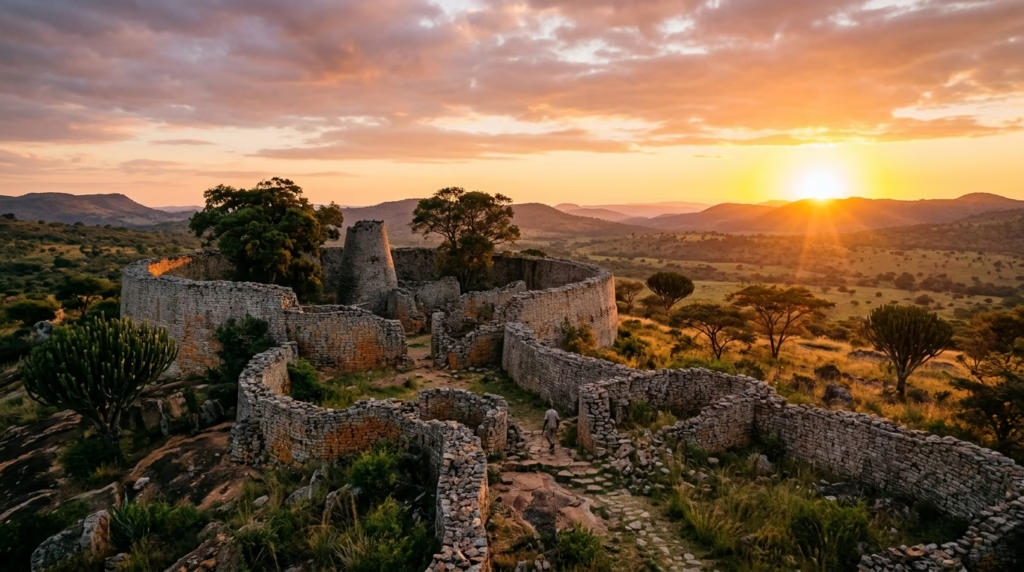
You’ve heard the name “Shona” all your life. It’s on identification documents, it’s printed in history textbooks, and it’s how the rest of the world identifies the majority of Zimbabwe’s population. It is a name carried by millions with deep cultural pride.
But here is a piece of history that might surprise you: your ancient ancestors never called themselves Shona.
In fact, before the colonial era, the concept of a single “Shona nation” didn’t exist. Today, we are playing historical detective and going back before the name was ever popularized to answer a simple question: Who were the people before the label, and where did the word “Shona” actually come from?
Tiri Vanhu: Who Were the People Before the Name?
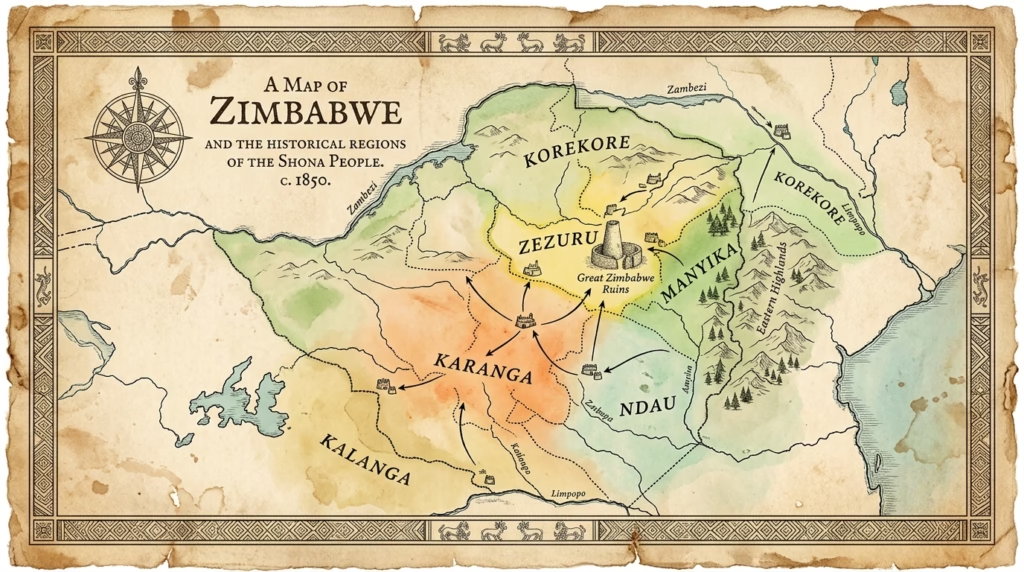
Before colonial administrators arrived, there was no single umbrella term for the people living in what is now Zimbabwe. Instead of one massive ethnic group, people identified with smaller, tightly-knit groups defined by their region, royal house, dialect, and clan.
If you asked someone their identity a few hundred years ago, you would hear names like:
- Karanga
- Manyika
- Zezuru
- Korekore
- Ndau
- Kalanga
These weren’t just “dialects” in the modern sense. They were sovereign identities, deeply tied to specific kingdoms, chiefs, and ancestral lands. The culture and bloodlines were ancient—tracing back to the builders of Great Zimbabwe and the mighty Kingdom of Mutapa.
When these groups needed a broader term to describe themselves collectively, some historical accounts suggest they simply used the phrase Tiri Vanhu—meaning, “We are people.” Their shared, mutually intelligible language was simply called Chivanhu (the language of the people).
Not a tribe name. Not a nation name. Just a human collective.
4 Competing Theories: How the Word “Shona” Was Born
If the ancestors didn’t use the word, who invented it? Historians and linguists actually disagree on its exact origins, leaving us with four fascinating theories.
1. The Ndebele Theory (The “Defeated” Origin)
This is the most widely taught theory in Zimbabwe. It suggests the word came from the Ndebele people during the conflicts of the 19th century. According to this version, the Ndebele used the word ukutshona—meaning “to sink” or “to go down”—to describe the groups they defeated in battle (particularly the Rozvi). Under this theory, the name began as a military insult to describe a subjugated people, which is why the original inhabitants didn’t use it themselves.
2. The “Sunset” Theory
Another geographical theory traces the name to the Kalanga word Ntshonalanga, which translates to “where the sun sets” (the west). It was originally used to describe the western territories of the region. Over time, European settlers and explorers corrupted this term into “Mashonaland.”
3. The Ancient Maps Theory (Older Than the Wars)
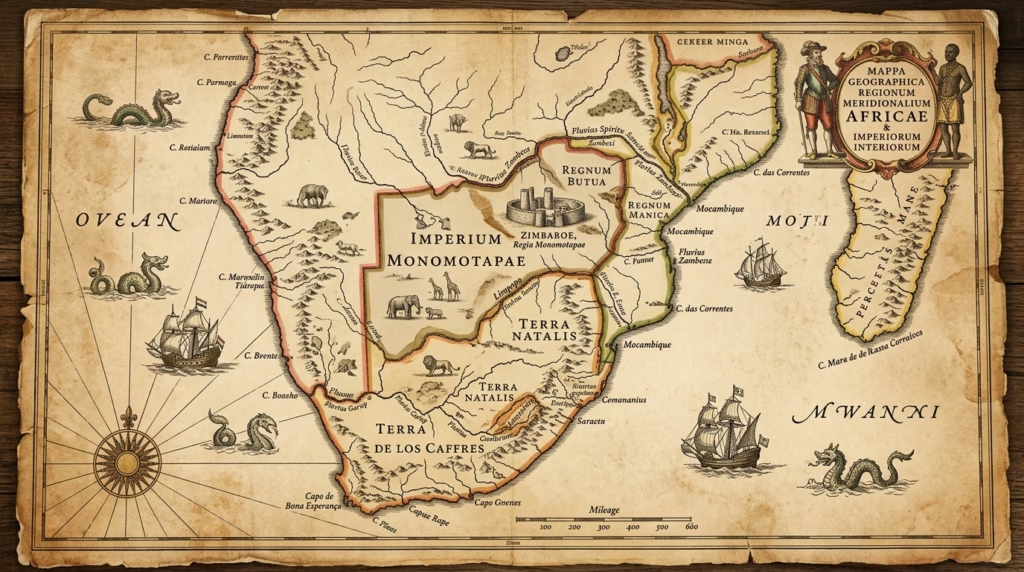
This theory completely disrupts the famous Ndebele story. Some historians point to old European maps and Portuguese travel journals from the 1600s and 1700s that clearly use words like Sajona, Soyouna, and Matshone to describe the people of this region.
Why is this huge? Because these maps were drawn long before the Ndebele arrived in the 1830s. If these records are accurate, the name “Shona” existed centuries earlier than the “insult” story claims.
4. The Gold Trade Theory
Perhaps the most unusual theory links the name to the ancient Indian Ocean trade networks. For centuries, the region was famous globally for its gold. In Hindi, Gujarati, and Punjabi, words like sona and sohna mean “gold” or “beautiful.” Some scholars suggest early traders used this term to describe the gold-rich inland empires, and the name stuck.
The 1931 Doke Report: How “Shona” Became Official
Regardless of whether the word came from ancient gold traders, Ndebele warriors, or old Portuguese maps, historians agree on one major fact: “Shona” was not used as a unified identity until the 20th century.
The turning point was the early 1900s, driven by colonial administrators and Christian missionaries who needed a way to easily govern, tax, and educate the local population. To do this, they needed one standardized language and one simple name.
Enter the 1931 Doke Report.
Led by linguist Clement Doke, this official commission took all the distinct dialect groups—the Karanga, Zezuru, Manyika, and others—merged them into a single standardized language for schools and administration, and officially locked in “Shona” as the blanket name for both the language and the people.
Just like that, a diverse network of ancient kingdoms was bundled under a label that is, at most, 150 to 200 years old.
Why Knowing This History Matters Today
This history is not about discarding the name “Shona.” Today, it is an identity that millions of people carry with fierce pride, representing a beautiful, rich, and vibrant modern culture. That shared modern identity matters deeply.
However, names carry history. Knowing that your ancestors defined themselves not by an outsider’s label, but by their clan, their kingdom, and simply by being Vanhu (people), changes how you view the past. The culture is ancient; the label is recent. Sometimes, understanding where your name came from tells you just as much about who you are as the name itself.
Did your grandparents or family elders use a different name for themselves before “Shona” became the standard? Share your family’s oral history and let’s keep the true history of Chivanhu alive in the comments section below.
Checkout: How Standardisation Almost Killed the Shona Language
Watch Shona Origins Video PART 1 Here: How a Language Was Standardised | And Why Some Shona Peoples Are Still Angry
PART 2: Where Did The Word Shona Actually Come From? | African History